
Unlimited tokens.
Any provider. Forever.
A residential proxy that lives inside OpenCode. It holds its own egress, repairs its own tunnel, and when a free tier cuts the turn it forks your session with the full context and keeps going — on any provider, any model, without changing your workflow.
Capabilities
Everything the harness does not do for you.
OpenCode gives you the agent. It does not give you an egress that survives a rate limit, a tunnel that repairs itself, or a session that comes back from a quota wall. That is the whole plugin.
Fork-first recovery
A provider quota error is not a dead end. The plugin forks the failed task root with its full projected history, refocuses the tab, and queues a resume nudge. The turn continues on a fresh egress instead of dying in a toast.
- Walks parent_id up from subagents
- 3 reforks by default, configurable
- Falls back to a continuation prompt
One egress per session
OpenCode v2 shares a single server across every TUI. The model.request hook resolves the route per session, so three tabs hold three different IPs at the same time.
Probe-gated rotation
No blind switching. Every rotation completes a CONNECT probe first; a dead upstream is quarantined and the same request is retried, so the client never sees the 502.
Key ⇄ proxy binding
One API key, one frozen proxy. Switch keys and the refork carries its own egress with it. Multi-key per provider, raw secrets kept 0600 and hashed on disk.
See the real menusTransport self-repair
The “Cannot connect” class: dead ports reaped, stale proxy vars unset, tunnels re-established before the request leaves the process.
Models are live telemetry
The sidebar exposes fork generation, sessions, reforks, re-identified message IDs, token totals and the last five proxies — with counts frozen per generation.
- GEN 3
- 879 MSG / 3 SESS
- TOT 790k TOK
- 5 PREV proxies
Recovery
When the wall comes, the session climbs over it.
Most plugins rotate an IP and hope. This one keeps the task alive: the same context, the same files, the same turn — moved onto an egress the provider has not met yet.
A free tier cuts the turn
The classifier separates an account quota from a bad IP, a transport fault and a plain user abort. Only the cases a new egress can actually fix are recovered.
The failed root is forked
session.fork copies the full projected history into a child and re-identifies every message. Parent stays untouched, so nothing is lost if recovery is refused.
A new route, a resume nudge
The child claims a fresh probe-verified upstream, takes focus in the TUI, and gets a queued resume. The interrupted turn finishes on its own — no “continue this id” ritual.
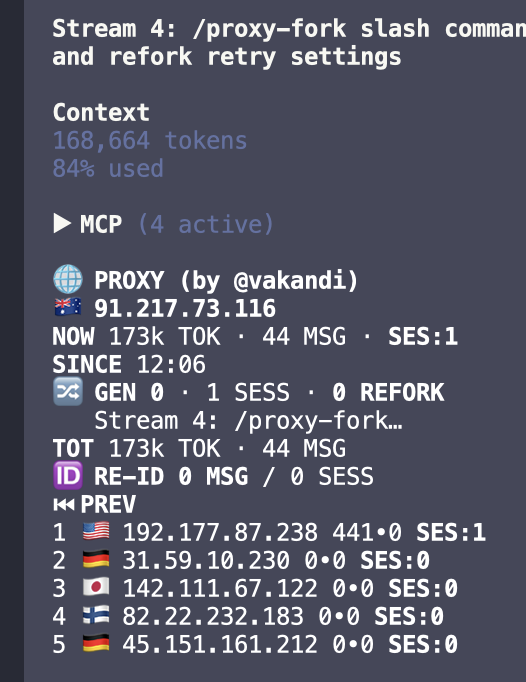
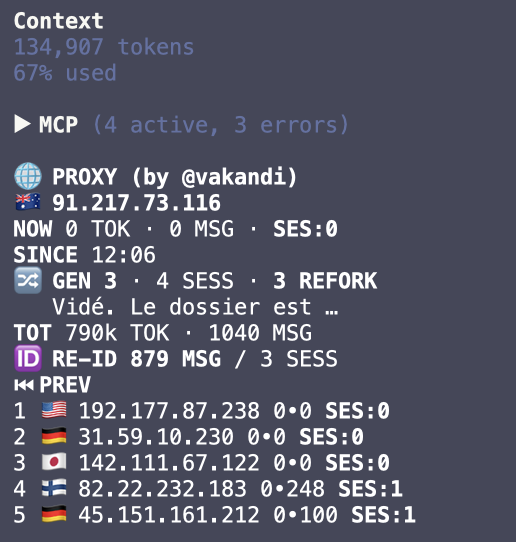
Left: fresh fork family · GEN 0 · 1 SESS · 0 REFORK
Right: after three reforks · 879 MSG / 3 SESS re-identified
Controls
Three commands. Not a single chat message.
Switching an IP, reforking a session and moving a key all happen in a menu. Nothing you do here enters the conversation, so nothing you do here costs a token or pollutes the context.

/proxy-fork
Fork session behind a fresh proxy
/proxy-keys
Manage API keys per provider
/switch-proxy
Switch proxy IP
live TUI capture
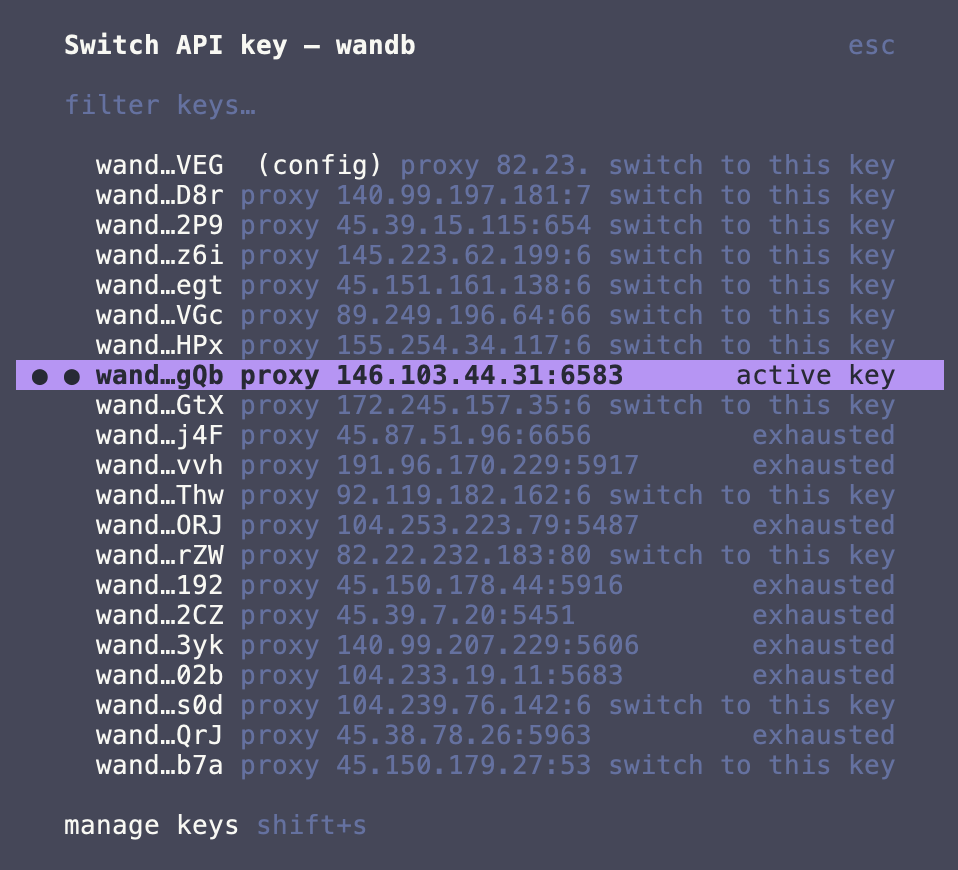
Every key carries its own exit
One row per key, one frozen proxy per row. Picking a row reforks the session behind that key's egress, so the provider sees a different account and a different IP in the same move. `exhausted` keys stay listed but are never reused.
- active key
- switch to this key
- exhausted
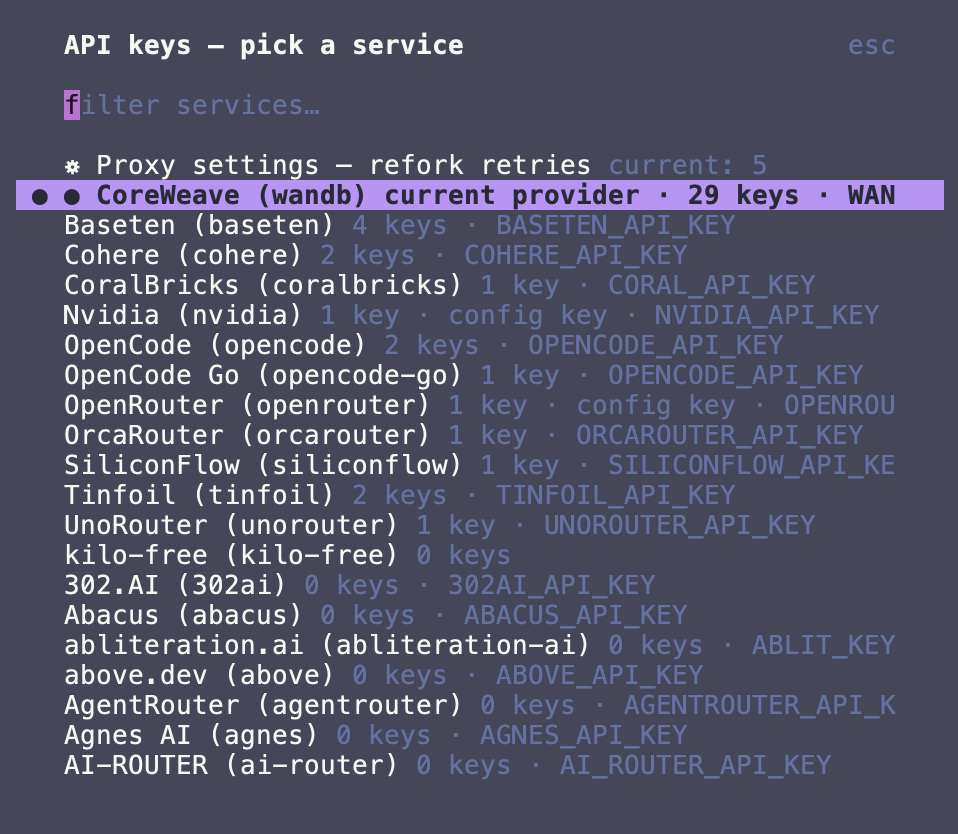
A fleet, not a single account
Twenty-nine keys on one provider, four on the next, one on a dozen others. The same screen carries the refork budget — this fleet runs five retries where the plugin default is three.
- 29 keys
- refork retries 5
- current provider
The pool
The plugin is the engine. The IPs are the fuel.
Two methods ship with the purchase. One costs nothing and needs some upkeep. The other costs about three dollars a month and needs none.
Free pool method
Build the pool yourself and let the plugin keep it honest. You get the sources worth scraping, the probe that kills dead IPs before they reach a request, and the dedup pass that keeps one exit from burning twice.
- Harvest script + curated aggregator sources
- node scripts/check.js --update liveness probe
- Dedup by real exit IP, not by host:port
- Country resolution for the TUI picker
trade-off: public IPs die, so you re-run the probe.
100 residential IPs
$3/moThe exact provider, the plan, the credential format and the refresh cron. One hundred clean exits for roughly three dollars a month — enough to keep a multi-tab fleet from ever sharing an egress.
Both methods land in the same Telegram thread as the repo invite. Run one, run both, or bring your own pool — the format is IP:PORT:USER:PASS.
Four commands, then it runs itself.
No daemon to babysit, no cloud account, no relay in the middle. The listener is a few thousand lines of TypeScript running in the same process as your agent.
Drop it in
sync.sh copies the server and TUI modules into the live plugins-v2 directory and registers the v2 CLI entry. No patch to OpenCode itself.
Point it at a pool
One line per proxy, IP:PORT:USER:PASS. The pool only has to be bigger than your number of concurrent tabs — every session claims its own entry.
Forget about it
The listener starts with the service, gates the first request, picks a route per session, and repairs or rotates without a chat message.
macOS-first · Bun or Node 20+ · Linux works · Windows untested
Pricing
Pay once. Keep the egress.
No seats, no usage metering, no per-token cut. One payment, the private repo, and every update after it.
proxy-local
lifetimeOpenCode v2 plugin · private source
one-time
- Full private repo: server plugin, TUI plugin, sidebar plugin, key registry
- sync.sh plus a step-by-step install walkthrough
- Fork-first recovery wiring for OpenCode v2
- The free-pool method: sources, liveness probe, dedup
- The $3 / 100 IPs method: provider, plan, credential format, refresh cron
- Lifetime updates pushed to the same private repo
- Direct line on Telegram while you get it running
Only recurring cost: the IP pool. $3/mo for 100 residential exits — or $0 with the free method.
@token_detectivePrivate source drop — no refunds once the repo is shared. Ask everything you want before paying. Payment happens in the Telegram DM, not on this page.
FAQ
The honest version.
What it does, what it does not, and where the line between the two sits.

Talk to the seller directly
no checkout pagePayment, delivery and support all happen in that DM. The message below is pre-filled — send it as-is and you get the price, the payment link and the repo invite in one reply.
Hey — I want to buy your OpenCode plugin. $100 one-time: unlimited tokens forever, full bypass of the OpenCode harness, no matter the provider. Send me the payment details, the install steps and the proxy method.